

Making Hunger History: Year Two Progress
Year two of Make Hunger History—a bold, community-wide initiative to cut hunger in half for Minnesotans by 2030—has brought the work that is needed to make 90% of Minnesota households food secure into focus. We are concentrating on three areas that will really move the needle on food security: food, support, and stability. Together, we’ll deliver more food today, meaningful support for a better tomorrow, and long-term stability through community change.

Support: Finding Families Grocery Dollars

Stability: Turning Advocacy into Action
.
Food: More Food Where It’s Needed
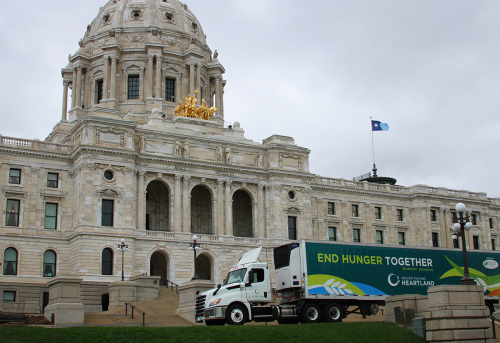
We believe that everyone should have access to nutritious food, and we are dedicated to getting the right food right where it’s needed. We have improved our infrastructure and diversified our approach to sourcing food for neighbors; used our mobile distribution trailer to expand our reach; and provided fresh, healthy meals through our Kitchen Coalition program to those who don’t have access. Finally, we are working with regional partners to address persistent family hunger issues and piloting new initiatives with our focus communities to support all our neighbors.
Community Highlights: Partnering to Expand Our Reach
St. Paul City School
As coordinator of partnerships at St. Paul City School, Shina Massey saw firsthand how deeply food insecurity affected many of her students.
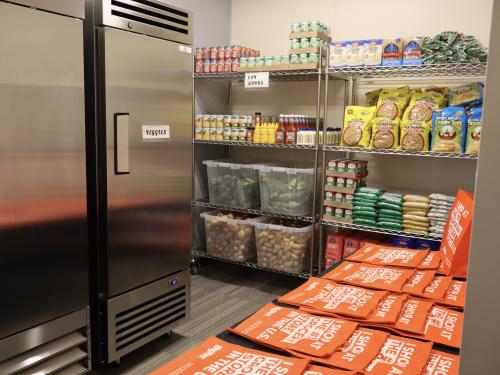
Inspired to help, she connected with Second Harvest Heartland to learn what it takes to open a food shelf. Second Harvest Heartland was then able to connect the school with Hy-Vee to fund the creation of a school-based food pantry. The employee-owned grocery store chain had recently made a commitment to reduce child hunger in their stores’ communities through helping schools create on-site school pantries.
“My goal is to listen to families and bring essential resources directly to them,” said Shina. “Creating a food pantry is another way we’re ensuring our students and families have what they need to thrive—both inside and outside the classroom.”
On September 25, 2025, the school opened its onsite pantry to serve 250+ families per distribution, creating a model that will be replicated in other high-need communities.
Minneapolis VA Healthcare System
Food insecurity is an issue that affects veterans at higher rates than non-veterans.
In May 2024, Second Harvest Heartland launched a food distribution program with the Minneapolis VA Healthcare System. Today, we provide food for monthly distributions serving over 300 veterans. Last year, this partnership served 6,045 veterans and their families from 2,954 households, distributing 81,533 pounds of food. This collaboration not only provides emergency hunger relief but also helps the VA connect veterans to health and wraparound services in a familiar setting.
“This partnership is solving a few different things for us,” said Minneapolis VA Director of the Center for Development & Civic Engagement Rachel Hammer. “We’re able to see veterans that we might not be connecting with in the healthcare system... The individuals are coming for the food, but seeing what else is available.”
Through this collaboration, Second Harvest Heartland created a new partnership model, allowing us to act as a fiscal sponsor and ensure compliance while the VA manages ordering, staffing, and data collection. In November 2025, Second Harvest Heartland launched a new partnership with the VA’s St. James Clinic. With the large impact we’ve already seen in Minneapolis, there is great potential to reach more veterans in rural communities, where food insecurity is often greater.
Willmar, MN
Willmar is a community experiencing real change.
Listening sessions convened by Second Harvest Heartland with neighbors and organizations in the central Minnesota city revealed major barriers to accessing the hunger-relief system: limited awareness of free food resources, a need for more than one visit per month, language challenges, a lack of halal options, and transportation hurdles.
In response, Second Harvest Heartland staff collaborated with community groups and the Kandiyohi County Food Shelf to create more welcoming, accessible services. We also helped Community Connectors Services open a new food shelf to bridge language gaps and provide culturally connected food.
Over 14 months in Willmar, we’ve increased overall food distribution by 45,000 pounds—a 10% growth—through strong partnerships and community‑guided strategies.
Ultimately, these community conversations helped unite organizations and neighbors around a shared goal: ensuring everyone has access to the food they need. Second Harvest Heartland served as the convener to spark that collaboration—and the community is carrying it forward.
.
Support: Finding Families Grocery Dollars
We believe that everyone should have access to nutritious food, and we are dedicated to getting the right food right where it’s needed. We have improved our infrastructure and diversified our approach to sourcing food for neighbors; used our mobile distribution trailer to expand our reach; and provided fresh, healthy meals through our Kitchen Coalition program to those who don’t have access. Finally, we are working with regional partners to address persistent family hunger issues and piloting new initiatives with our focus communities to support all our neighbors.
Care Center Highlights: 2025 Results & Story
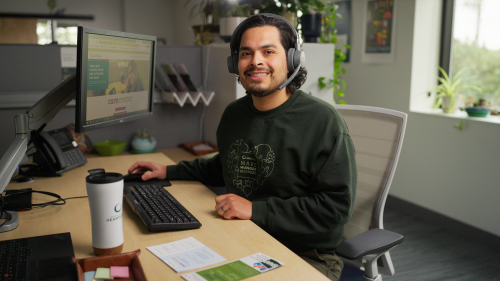
The Care Center Team is available five days a week, and help is available in English, Spanish, Hmong, and Somali with other languages available with support from telephonic interpreters. More than 14,000 households were assisted by the Care Center in our 2025 fiscal year.
A new, regularly updated food resource map is accessible on the Second Harvest Heartland website for anyone looking to find free food distributions in Minnesota. Web traffic tripled during the federal government shutdown in fall 2025 to 6,000 visits weekly.
Our advisors have implemented efficient new processes for steadily faster response times over the past year, despite higher call volumes. On November 26, neighbors who requested a callback via online form or email received same-day service for the first time. The Care Center strives for real-time responsiveness, frequently providing same-day or next-business-day callbacks.
Helping a Mother Navigate SNAP During the Government Shutdown
Over the course of several months, a neighbor worked closely with Care Center Advisor Aaron to navigate the SNAP application process made even more difficult by the government shutdown. When the neighbor first reached out, she was facing significant food insecurity while caring for a household of five, including newly arrived triplets. With her partner’s fluctuating monthly income and no personal income of her own, she was struggling to keep up with household needs.
During the initial call, the neighbor explained that she had applied for SNAP previously but never heard back from the county. Due to the shutdown, applications were temporarily on hold, creating barriers for families like hers. Together, Aaron and the neighbor completed a new application, submitted it to MNbenefits, and received a confirmation number. To help her bridge the gap, Aaron immediately provided an email with community food resources, including food shelf locations, emergency food distributions, and community meal sites.
In mid-November, the neighbor texted requesting help submitting supporting documents. Aaron helped upload these to the county through MNbenefits and confirmed successful submission. Later that month and into December, Aaron continued to conduct follow-up outreach, including an opportunity to review her case status and support her in preparing for the county interview, which was also impacted by the shutdown delays.
By early January, Aaron connected with the neighbor again. During this touchpoint, she shared encouraging news: her SNAP application had been approved, and she would be receiving her second set of benefits within the month. Despite the prolonged uncertainty caused by stalled federal systems, her persistence—paired with ongoing support and multiple check-ins—helped ensure nothing fell through the cracks.
.
Stability: Turning Advocacy into Action
Minnesota has one of the strongest hunger-relief networks in the country. But even with our collective impact, we’re still not meeting the growing demand. Our immediate goal is to make sure neighbors don’t go hungry, but ending hunger for good requires supporting the policies and programs that address its root causes.
We partner with advisory councils, private sector innovation leaders, and hunger relief experts to help guide our plan of action. We advocate for bipartisan policy change at the federal and state level, forming coalitions with other nonprofits as we seek to make people’s lives more affordable.
Advocacy Highlight: 2025 Legislative Session
2025 was a big year for hunger-relief advocacy at the Minnesota State Legislature. Hunger Day on the Hill had over 200 attendees—more than ever before! Attendees met with their state senators and representatives to discuss hunger relief policies that proposed to fund food banks, food shelves, and other local food programs across Minnesota. Furthermore, anti-hunger advocates sent more than 12,000 messages to state policymakers this year through the Second Harvest Heartland website.
As a result of our collective advocacy, the state Health and Human Services budget included this one-time funding for hunger relief:
- $5 million distributed between all Minnesota food banks and participating Tribal Nations
- $5 million additional funding for Minnesota food shelves, which will nearly double the funding available for the Minnesota Food Shelf Program grants this fall
- $1 million for the prepared meals competitive grant program
- $1 million for Tribal food security through the American Indian Food Sovereignty program
Second Harvest Heartland also convenes the Nourish MN Coalition, a group of more than a dozen nonprofits across sectors—including food security, housing, employment, healthcare, and transportation—to address the root causes of hunger through coordinated advocacy and collaboration. Each year, the Coalition identifies 8-10 high-impact policies to address poverty – and by extension, hunger – and works together to advocate for them at the Capitol. Most of these priorities will require multiple legislative sessions to achieve, but the cross-sector effort is new and, hopefully, will lead to long-term success.
.
2025 Statewide Hunger Study Results
The centerpiece of our plan to track shared Make Hunger History progress is the Statewide Hunger Study. We partnered with Wilder Research on this high-resolution look at hunger across the state, to identify the kinds of support families are using to meet their food needs and where more help is needed.
The latest results of the yearly survey were released in February 2026. Among the report’s key findings:
- Today, 1 in 5 Minnesota families still can’t afford the food they need. In a country with as many resources as ours, that is simply unacceptable. Our hunger relief network is working around the clock to bridge that gap, but the data suggest even bigger challenges are on the horizon.
- Nearly half (42%) of Minnesota households are worried they won't be able to make ends meet in the year ahead. They’re feeling the pinch because while their paychecks have stayed the same, wages have stagnated and the cost of living continues to climb.
- Affordable housing, healthcare, and steady employment are the main drivers—or derailers—of household stability in Minnesota. Those costs, combined with childcare and transportation have made it hard to make ends meet these last few years.
- To feel more secure, most families say they either need better-paying jobs or some relief from medical bills. With daily living expenses still on the rise, many Minnesotans are struggling to keep up.
- The good news is that our hunger relief network is holding steady, providing food aid to 20% of the state. But food banks alone can’t fix this. Without better federal support and meaningful changes to the way we address hunger, the future looks incredibly tough for many.
These numbers show the stark reality of food insecurity in our state and outline the work that needs to be done to cut hunger in half for all Minnesotans by 2030. Second Harvest Heartland will continue conducting comparison studies during each year of the Make Hunger History initiative. With these areas of focus, combined with the efforts of our partners and the generous support of our advocates and donors, we are confident in our mission of ending hunger together.

Make Hunger History
Learn more about the effort to
We’ve set a course to cut hunger in half for all Minnesotans by 2030. Learn more about how we're going to reach more of our neighbors, while powering-up partnerships to get more of the right food where it’s needed most. With new coalitions, innovative one-on-one services and policy change, it’s possible to end hunger altogether in our state.
.